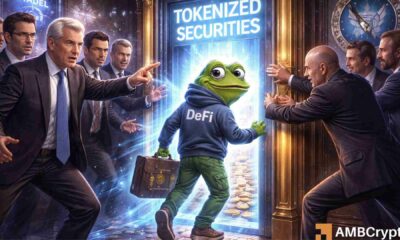
Robinhood CEO: Five Years After the GameStop Incident, We Are Committing to Unlocking Real-Time Settlement for Retail Traders Through Tokenization

marsbit2026-01-29 tarihinde yayınlandı2026-01-29 tarihinde güncellendi

Özet

Five years after the GameStop trading halt, Robinhood CEO Vlad Tenev reflects on the event and outlines the company's push for real-time settlement through tokenization. The 2021 trading restrictions were caused by legacy clearinghouse risk rules tied to the slow T+2 settlement cycle, which required massive capital reserves during periods of high volatility. While advocating for and achieving T+1 settlement in the initial response, Tenev argues it remains insufficient in today's 24/7 markets. The solution is tokenization—converting stocks into blockchain-based tokens. This enables real-time settlement, drastically reducing systemic risk, lowering costs, and allowing for features like 24/7 trading, fractional ownership, and DeFi integration. Robinhood has already launched over 2,000 tokenized US stocks in Europe, with plans to enable round-the-clock trading and self-custody. Tenev emphasizes that US adoption requires a clear regulatory framework, noting recent SEC openness to innovation and the importance of the CLARITY Act in establishing modern rules for stock tokenization. The goal is to prevent future trading restrictions and fully unlock real-time settlement for retail investors.

Author: Vlad Tenev, Co-founder and CEO of Robinhood

Compiled by: Hu Tao, ChainCatcher

What exactly happened? And how can we ensure such an event never happens again?

Five years ago today, Robinhood and other brokerages were forced to halt purchases of several "meme stocks," most notably GameStop. It was one of the most bizarre and dramatic stock market crashes in recent memory.

The root cause of this trading halt lay in a complex set of clearinghouse risk management rules designed to mitigate the risks stemming from the then two-day settlement cycle for U.S. stock trades. These rules required brokerages to deposit massive amounts of capital to cover the risk between the trade and settlement of these highly volatile "meme stocks." What happens when slow, antiquated financial infrastructure collides with unprecedented trading volume and volatility in a handful of stocks? Massive deposit requirements, trading restrictions, and millions of angry customers.

Retail investors trying to buy GameStop stock were understandably furious. In their eyes, Robinhood went from hero to villain. I was just one month into my role as CEO of Robinhood, facing my first major crisis. After many team members worked around the clock for 72 hours to address the immediate fire and raise over $3 billion to shore up our capital reserves, we finally had a moment to step back and assess the situation. I vowed to do everything in my power not only to improve Robinhood's resilience in a similar scenario but also to advocate for systemic improvements to ensure such an event never happens again.

We strongly advocated for real-time settlement of U.S. stock trades, ultimately helping to shorten the settlement cycle from 2 days (T+2) to T+1—arguably the most significant achievement during Gensler's tenure as Chair of the U.S. Securities and Exchange Commission (SEC), despite the otherwise regrettable aspects of that period.

But in an era of 24-hour news cycles and real-time market reactions, a T+1 settlement cycle is still too long, especially when it effectively becomes T+3 on Fridays and T+4 over long weekends. Our pursuit of real-time settlement continues, but within the traditional stock market, achieving it has been elusive due to the need to manage numerous legacy stakeholders. Clearly, a new approach was needed.

Enter tokenization. Tokenization is the process of converting an asset, like a stock, into a token that exists on a blockchain. Among its many advantages—such as lower costs, native fractionalization, and 24/7 trading—putting stocks on-chain as tokens allows them to benefit from the real-time settlement properties of blockchain technology. The elimination of long settlement cycles means significantly reduced systemic risk and less strain on clearinghouses and brokers, allowing customers to trade freely, anytime, anywhere.

We've already seen this approach work. In Europe, Robinhood has launched tokens representing over 2,000 U.S.-listed stocks. These tokens allow European traders to invest in U.S. equities and receive dividend payments. In the coming months, we plan to enable 24/7 trading and decentralized finance (DeFi) services, where investors can self-custody their stock tokens and engage in activities like lending and staking.

As the advantages become increasingly clear, I believe it's imperative for the U.S. to embrace this technology. We are already seeing some progress: major U.S. exchanges and clearinghouses recently announced plans for stock tokenization.

But without a clear regulatory framework, these efforts will be in vain. Fortunately, we now have a prime opportunity. The current leadership at the U.S. Securities and Exchange Commission (SEC) is actively embracing innovation and encouraging experimentation with tokenization. Furthermore, Congress is actively considering the CLARITY Act, significant crypto legislation that would require the SEC to continue advancing this technology and establish modern rules for stock tokenization. This act would ensure that subsequent SEC leadership cannot abandon or reverse the progress made by the current commission.

By working with the U.S. Securities and Exchange Commission (SEC) and advocating for sound U.S. stock tokenization guidelines through CLARITY, we can collectively ensure that trading restrictions like those in 2021 never happen again. Let's seize the moment and finally unlock real-time settlement for retail traders.

İlgili Sorular

QWhat was the root cause that forced Robinhood and other brokers to halt purchases of meme stocks like GameStop five years ago?

AThe root cause was a complex set of clearinghouse risk management rules designed to mitigate the risk from the two-day settlement cycle (T+2) for US stock trading at the time. These rules required brokers to deposit huge amounts of capital to cover the risk between the trade and settlement of the highly volatile meme stocks.

QWhat specific improvement did Robinhood advocate for and help achieve in the US stock settlement system after the incident?

ARobinhood advocated for real-time settlement and helped achieve a reduction of the US stock settlement cycle from two days (T+2) to one day (T+1).

QAccording to the article, what is tokenization and what is its key advantage for stock trading mentioned in relation to settlement?

ATokenization is the process of converting assets, like stocks, into tokens that exist on a blockchain. Its key advantage for settlement is that it enables real-time settlement, which eliminates the long settlement cycle, drastically reduces systemic risk, and relieves pressure on clearinghouses and brokers.

QWhat has Robinhood already launched in Europe that demonstrates the feasibility of tokenizing US-listed stocks?

AIn Europe, Robinhood has launched over 2,000 tokens representing US-listed stocks, which enable European traders to invest in US stocks and receive dividend payments.

QWhat US legislative act does the article mention as being crucial for establishing a regulatory framework for stock tokenization?

AThe article mentions the CLARITY Act, a significant piece of crypto legislation being actively considered by Congress, which would require the SEC to advance this technology and create modern rules for stock tokenization.

İlgili Okumalar

Once Laughed at as Crazy, Now Studied Frame by Frame: Justin Sun and the Decade-Long Comeback of 'Sun Studies'

The article chronicles the decade-long transformation of Justin Sun's public perception from being ridiculed to becoming a subject of intense study, known as "Sun Studies" or "Sun Xue." In early 2026, his decade-old book, *The World is Both Cruel and Tender*, surged to the top of WeRead's bestseller list, sparking widespread discussion on social media about his methods and philosophy. The core of "Sun Studies" is summarized as the "essence of winning." Despite an ordinary background, Sun made high-risk, high-reward bets throughout his career, from leveraging Bitcoin and Tesla stock to entering the crypto world. He consistently stayed at the table through regulatory shifts, market crashes, and public criticism, exemplified by his strategic acquisition of Huobi HTX. His investment philosophy centers on "doing what is correct from the future's perspective." This was demonstrated by his early bets on disruptive trends, founding the TRON blockchain, acquiring Steemit, purchasing and tokenizing a Picasso painting, and promoting concepts like the HTX DAO and decentralized platforms. The article draws a parallel between Sun and Elon Musk, describing Sun's tactics as a form of "dimensional reduction attack" from an outsider's perspective. His headline-grabbing stunts, like the record-breaking巴菲特午餐 (Buffett lunch) and eating a $6.2 million artwork banana, were calculated moves to capture global attention and reshape value perception through consensus and narrative. A key tenet of "Sun Studies" is the rejection of traditional stability. Sun advocates embracing uncertainty as the true incubator of wealth and freedom, allowing one to avoid compromising values for money. The article concludes by highlighting his most formidable, and perhaps inimitable, trait: an unyielding will and resilience that allowed him to thrive under immense pressure and constant scrutiny. Ultimately, "Sun Studies" represents a clear-eyed realism—acknowledging the world's cruelty while recognizing it rewards those who understand its rules and are willing to face the consequences.

marsbit3 dk önce

Once Laughed at as Crazy, Now Studied Frame by Frame: Justin Sun and the Decade-Long Comeback of 'Sun Studies'

marsbit3 dk önce

Understanding Premium Rate: Stay 24 Hours Ahead of ETF Data

Understanding ETF Premium Rates: A 24-Hour Advantage in Crypto Trading With the approval of BTC and ETH spot ETFs, daily fund flows have become a critical indicator for traders. However, this data is delayed by one day, often causing market prices to reflect the information before it is officially published. A key real-time indicator to anticipate ETF net inflows or outflows is the **ETF premium rate**. The premium rate reflects the difference between an ETF's market price and its net asset value (NAV). A positive premium suggests bullish sentiment and potential inflows, while a negative premium indicates bearish sentiment and likely outflows. Data from January 2026 showed that negative premium rates occurred on 16 out of 18 trading days, with 11 of those days resulting in net outflows. A longer-term analysis (July 2025 to January 2026) revealed an **81% accuracy rate** for negative premiums predicting outflows and **84%** for positive premiums predicting inflows. The mechanism behind this involves Authorized Participants (APs) who perform arbitrage: - A positive premium prompts APs to create ETF shares (buying underlying assets → net inflow). - A negative premium leads to share redemption (selling assets → net outflow). To use premium rates effectively: 1. Focus on **sustained trends** rather than one-day values. 2. Watch for **extreme values** (e.g., beyond ±1%), indicating strong sentiment shifts. 3. Consider **price context**—high prices with negative premiums may signal sell-offs, while low prices with positive premiums may indicate accumulation. However, premium rates should not be used alone. Combine them with: - ETF holdings change - Futures basis and funding rates - Put/Call ratios - On-chain whale movements and exchange inflows/outflows Multi-dimensional analysis improves accuracy. While no indicator is perfect, premium rates offer a timely glimpse into fund flows, giving traders an informational edge.

marsbit47 dk önce

Understanding Premium Rate: Stay 24 Hours Ahead of ETF Data

marsbit47 dk önce

İşlemler

Spot
Futures
活动图片